DATEV
Last updated: June 16, 2026
This guide explains how to activate your connection to DATEV using the local DATEVconnect API.
Two different ways of exposing the local DATEVconnect API are described below. If none of these methods work for your setup you will need to use the Local Agent connection method. In that case, contact your software provider so they can redirect you to the alternative setup. The Local Agent method is explained in a separate here.
📋 Overview
This integration connects with two DATEV components:
DATEV Rechnungswesen – On-premise accounting software (main data source)
DATEV Unternehmen Online (DUO) – Cloud portal used only for sending attachments such as documents, invoices, or receipts
If you don’t plan to send attachments, DUO is not required.
⏱ Estimated time:
👉 You will need to contact your DATEV IT service provider or integrator and request that they expose the DATEV API URL (fully detailed in the Network & Server Access subsection of the Prerequisites). If they agree, this step usually takes only about 2 minutes 😉.
2 minutes to retrieve and complete the activation page. (Make sure your system meets all the conditions listed in the Prerequisites section below.)
🚨 PREREQUISITES (conditions to be met prior to connection)
1. Licenses
Licences | Requirement descriptions |
DATEV Rechnungswesen licence | Mandatory. Owned either by your company or provided through your accountant/tax advisor. |
DATEVconnect licence | Mandatory. Enables API access. Usually already included in DATEV installations but must be activated. If missing, you can order it (free) via DATEV’s shop. |
DATEV Unternehmen Online (DUO) licence | Only required if attachments (PDFs, invoices, receipts) will be sent to DATEV. |
How to confirm licenses:
In DATEV Arbeitsplatz, go to Licence Management (Lizenzverwaltung) to view installed licences.
Or request confirmation from your DATEV administrator, accountant (Steuerberater), or DATEV service partner.
2. Network & Server Access
For this part, it requires involving your DATEV IT service provider or DATEV integrator.
To allow Chift to communicate with DATEV via the DATEVconnect API, the DATEV server must be reachable externally through a secure HTTPS endpoint. You can achieve this in two different ways:
1. Expose the DATEVconnect API URL
Your DATEV administrator or IT provider must configure an external HTTPS endpoint that routes traffic to your DATEVconnect service.
Typical internal endpoints: https://<local-server>:58452
The exposed endpoint must be reachable from Chift systems remotely via HTTPS.
Required network configuration
Open and forward external access to ports 58452
Configure NAT/firewall rules to route incoming HTTPS traffic to the internal DATEV server
Ideally restrict access ideally with a dedicated request header (Chift)
If your DATEV service provider refuses to expose the URL due to security rules or DATEV guidelines, you must use the second method described below or use the Local Agent method.
User Account Requirements
You must provide the Windows username and password of a Windows user account that is linked to a DATEV user with the following permissions:
✔ Access to the relevant mandate/company in DATEV Rechnungswesen
✔ Rights to use the DATEVConnect service
✔ Sufficient rights to read/write accounting data (depending on integration scope)
DATEV requires that API authentication is conducted using a Windows login that is mapped to a DATEV user account. This mapping is configured in DATEV Benutzerverwaltung (User Management).
2. Use Riecken Cloud Gateway
Riecken offers a Cloud Gateway to externally access your local DATEVconnect API. To use this service you need to take contact with Riecken and contract with them directly. More information about this possibility is explained here: https://cloudgateway.riecken.io/index.html
⚡️ CONNECTION
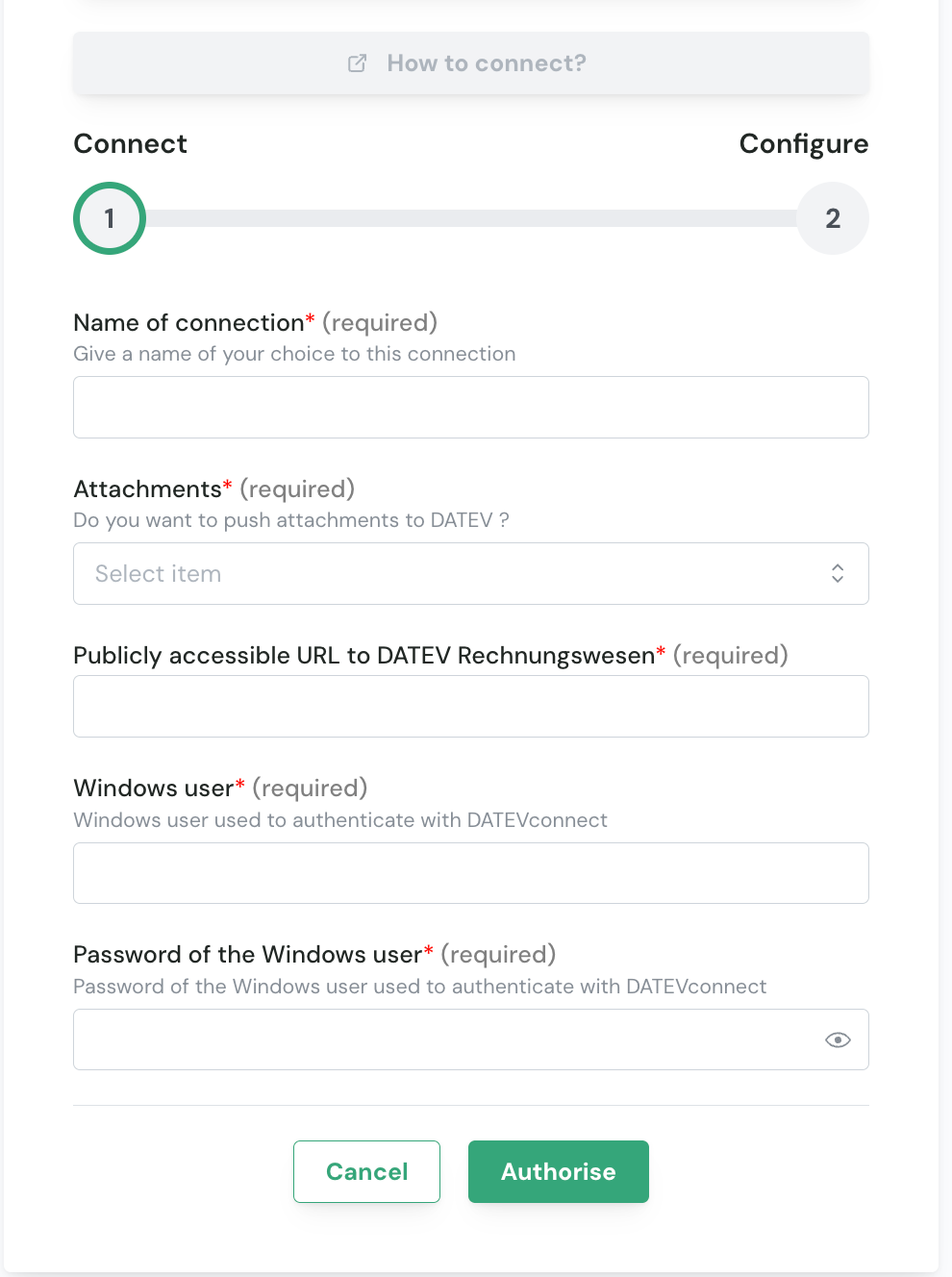
Step 1: Choose a name for your connection. (If the connection name field isn’t visible, simply skip this step and continue.

Step 2 : Choose whether you want to send attachments
If you don’t see this option, it means your software provider preset this setting for you.
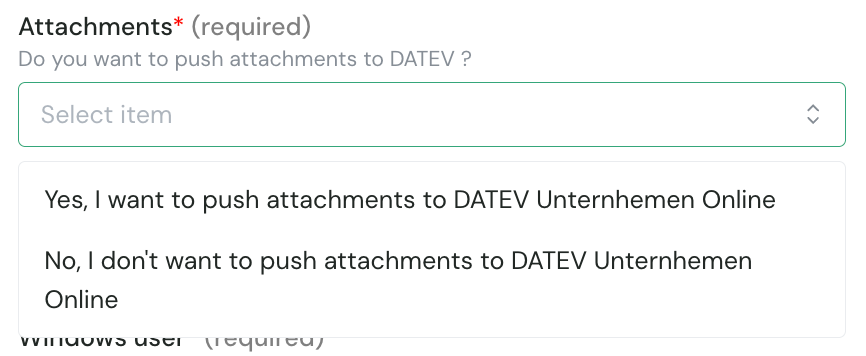
If your integration needs to send PDF invoices, receipts, or supporting documents to DATEV, select Yes to enable attachments.
This requires a valid DATEV Unternehmen Online licence (see above in prerequisites section)
Step 3 : [Only if attachments enabled / DUO selected] Enter your Consultant Number and Client Number.
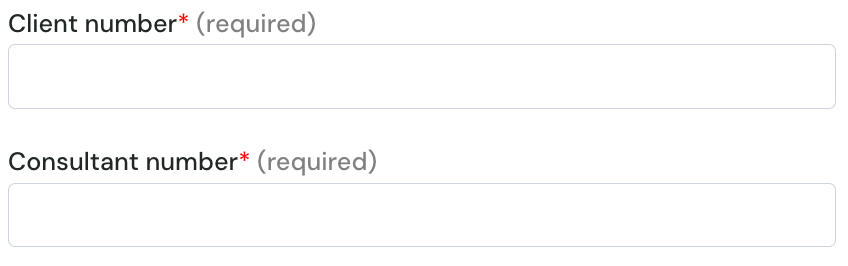
Enter your Consultant Number and Client Number.
Where to find them ? 👇
Go to DUO sign-in page
Click Show document overview
The numbers are shown on the right, below Settings:
First number = Consultant Number (5696507 in the example)
Second number = Client Number (55003 in the example)

Step 4 : Enter the remotely accessible DATEVConnect API URL (HTTPS)

Step 5 : Fill in you Windows user and password linked to DATEV account
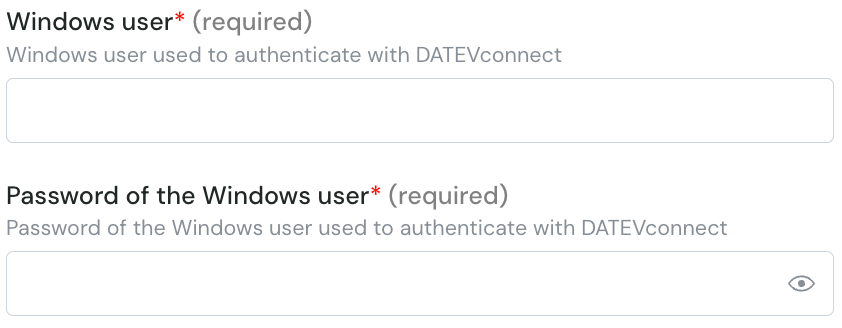
Enter the Windows username and password of the user linked to the DATEV account, as described in prerequisites.
If you choose to use Riecken Cloud Gateway you will need to fill in the information they provided you instead of a Windows username and password. Riecken will provide you 2 information:
Client ID: this information can be filled in the Windows user field
Client Secret: this information can be filled in the Password of the Windows user field
Step 6: Click "Authorise" to finalise the connection.

AUTHENTICATION - [Only if attachments enabled / DUO selected]
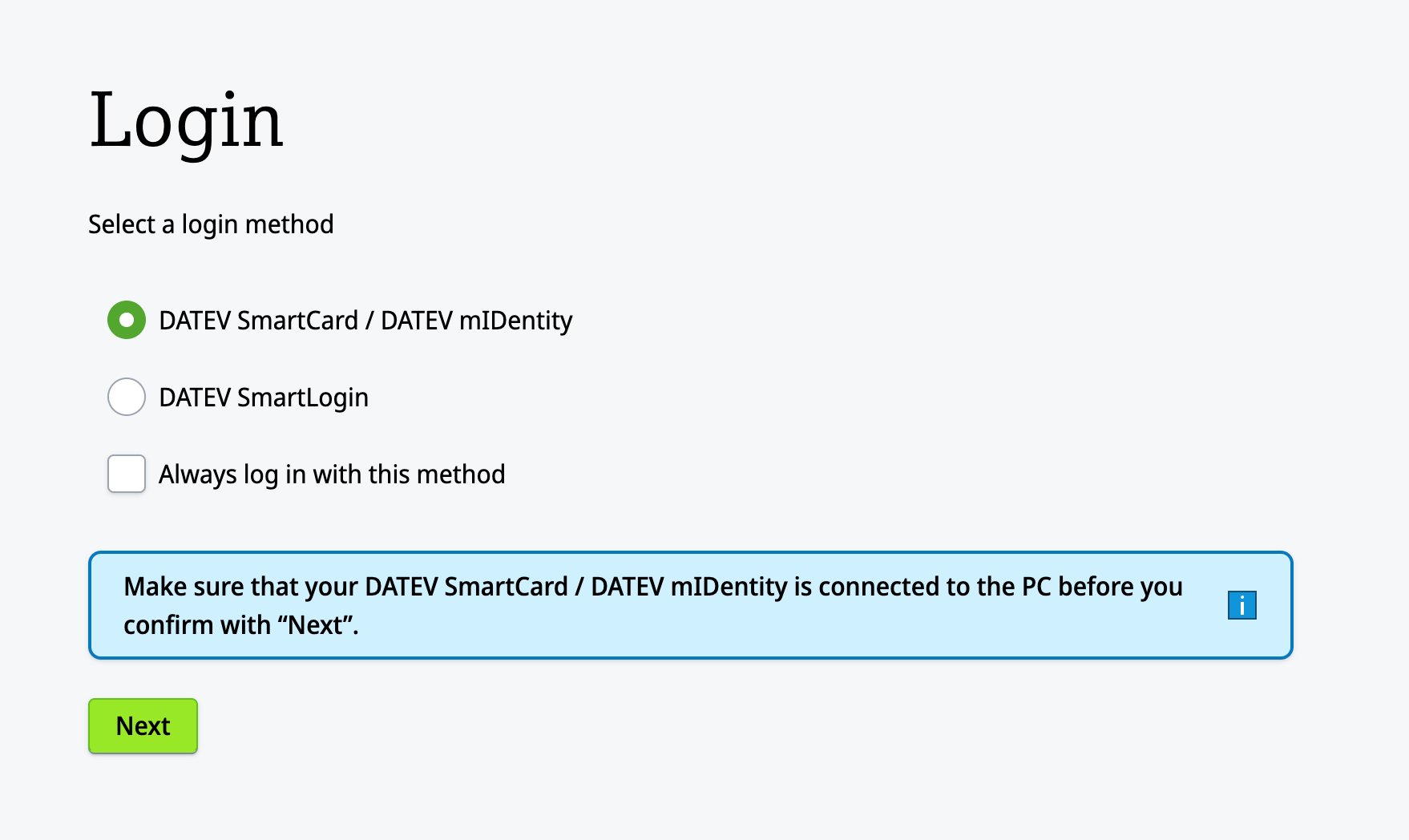
You will be redirect to the login page of DUO to authenticate yourself and authorise the connection.
You can log in using your SmartLogin or your SmartCard/mIDentity.
CONFIGURE
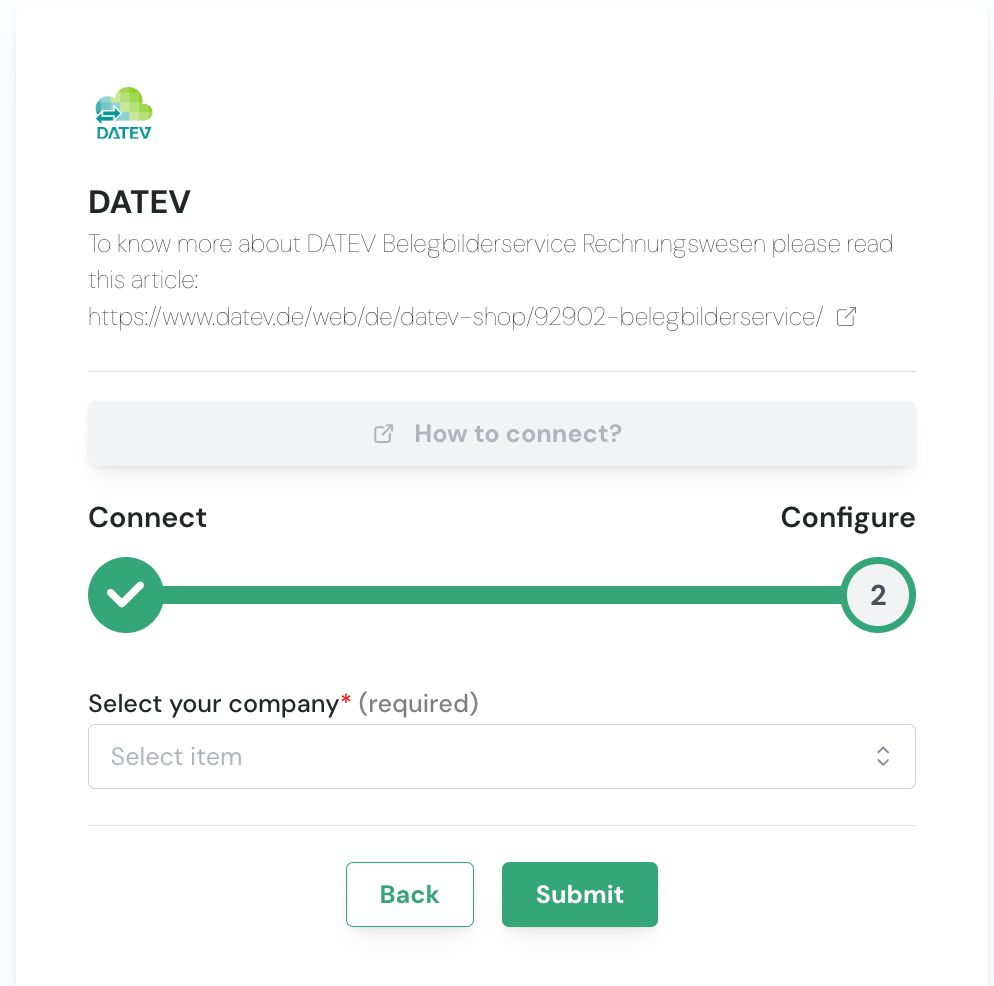
Select you company and click on "Submit".
Once done, your connection to DATEV will be fully active. 🎉 🕺